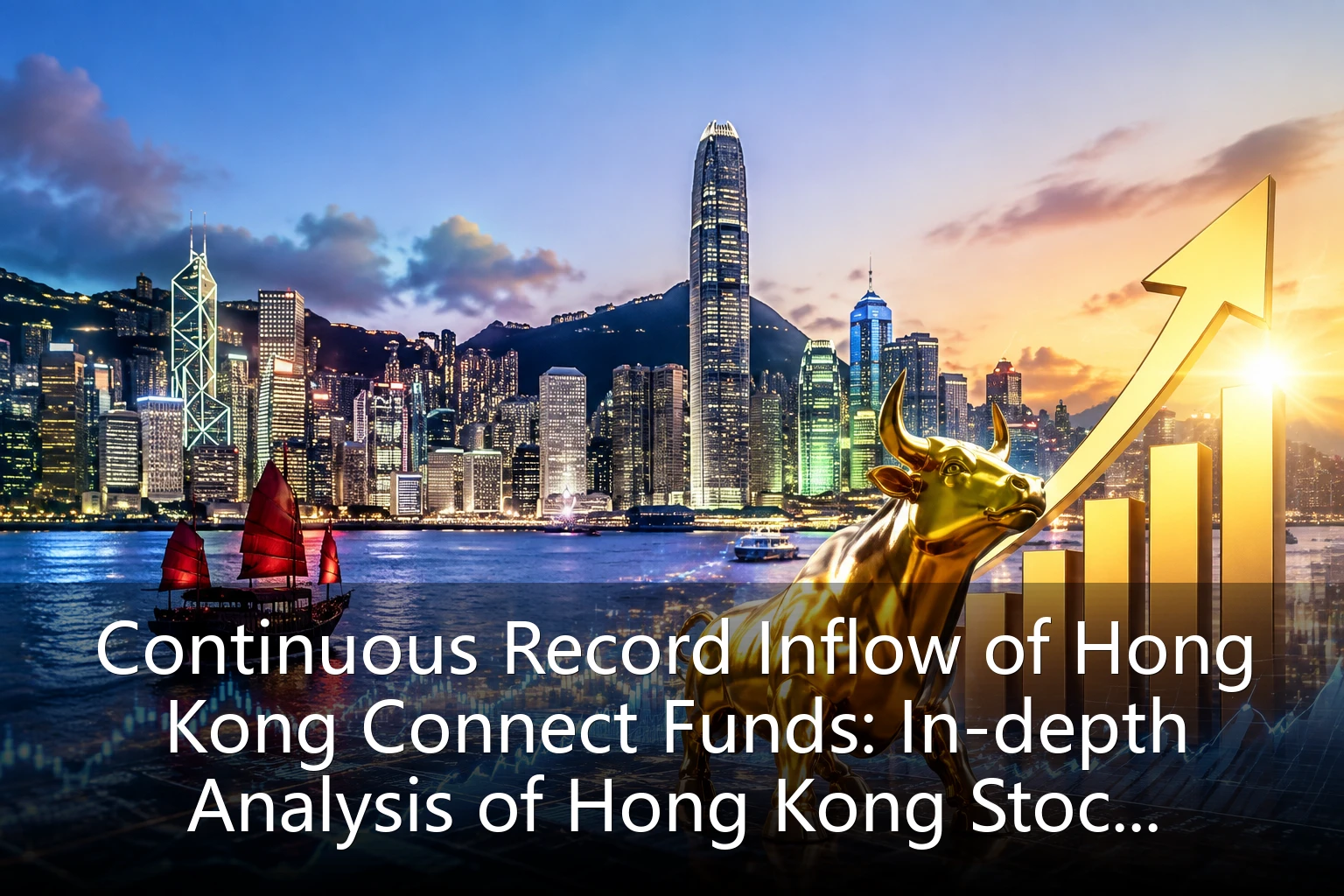
Continuous Record Inflow of Hong Kong Connect Funds: In-depth Analysis of Hong Kong Stock Investment Value in the Second Half of 2026
\nIn August 2026, the Hong Kong stock market once again became the focus of global capital attention. With continuous record inflows of Hong Kong Connect funds, the Hang Seng Index broke through the 25,000-point mark to reach a new high for the year, demonstrating the strong appeal and investment value of the Hong Kong market. As a global investment portfolio encyclopedia, this article will provide an in-depth analysis of investment opportunities, liquidity, valuation advantages, and risk warnings in the Hong Kong stock market, helping investors understand the trading logic of Hong Kong stocks and make informed decisions on account opening and asset allocation.
\n\nI. Hong Kong Connect Fund Flow: Global Capital Accelerating Embrace of Hong Kong Stocks
\nIn August 2026, the weekly net inflow of southbound funds through Hong Kong Connect broke records, maintaining a net inflow for 12 consecutive trading days, with cumulative net inflows exceeding 50 billion Hong Kong dollars. This data indicates that mainland investors are accelerating their allocation to the Hong Kong stock market, with continuously increasing recognition of Hong Kong stock value.
\n\nFrom the perspective of fund flow structure, high-dividend blue-chip stocks and technology stocks have become key allocation targets for funds. Against the backdrop of rising expectations for Federal Reserve interest rate cuts and a strengthening renminbi exchange rate, Hong Kong's low valuation advantage and high dividend characteristics have attracted a large amount of safe-haven funds. Meanwhile, with the recovery of the global technology industry, the Hong Kong technology sector has also gained favor from funds.
\n\nII. Unique Investment Advantages of the Hong Kong Stock Market
\nCompared to other international financial markets, the Hong Kong stock market has multiple unique advantages, making it an important choice for global investors' asset allocation.
\n\n- \n
- Significant Valuation Advantage: After long-term adjustments, the overall valuation of the Hong Kong stock market is at historical lows, especially with the Hang Seng Index's P/E ratio significantly lower than major global markets. The AH-share premium continues to narrow, making Hong Kong a value investment haven. \n
- High Dividend Returns: The Hong Kong stock market has numerous high-dividend quality enterprises with dividend rates generally between 4%-6%, far above the global average, providing investors with stable cash flow returns. \n
- Well-developed Market System: The Hong Kong stock market implements a T+0 trading mechanism, allows short selling, has high market efficiency, and a perfect price discovery mechanism, providing professional investors with abundant trading tools and strategic space. \n
- High Degree of Internationalization: The Hong Kong stock market brings together quality enterprises from around the world, especially mainland Chinese enterprises that list in Hong Kong for financing, providing international investors with opportunities to share in China's economic growth. \n
III. Hot Topics and Sector Opportunities in the Hong Kong Stock Market in the Second Half of 2026
\nIn the second half of 2026, the Hong Kong stock market will welcome multiple important events and structural opportunities, and investors need to focus on the following sectors and themes:
\n\n1. High Dividend Sector: Capital Safe Haven
\nAgainst the backdrop of slowing global economic growth and persistent inflationary pressures, the high dividend sector has become a safe haven for capital. Sectors such as utilities, telecommunications, and banking in the Hong Kong stock market have stable cash flows and high dividend policies, making them the preferred choice for defensive investors.
\n\n2. Technology Sector: AI and Digital Economy Dual Driving Force
\nWith the recovery of the global technology industry, the Hong Kong technology sector is presenting investment opportunities. Especially leading enterprises in artificial intelligence, cloud computing, and semiconductors are benefiting from the development of the digital economy and policy support, having long-term growth potential.
\n\n3. New Energy Policy Tailwind: Collective Surge in Wind, Solar, and Storage Sectors
\nUnder the carbon neutrality goal, new energy policies continue to strengthen, and enterprises in the new industry chain in Hong Kong are development opportunities. Sub-sectors such as wind and solar power, energy storage equipment, and new energy vehicles are expected to achieve excess returns.
\n\n4. Healthcare: AI Medical Concept Explosion
\nPopulation aging and medical technology advancement bring long-term growth momentum to the healthcare industry. Innovative pharmaceutical companies, medical device companies, and medical service providers in Hong Kong, especially those combining AI technology, have broad development space.
\n\nIV. Risks and Response Strategies for Hong Kong Stock Investment
\nDespite many advantages in the Hong Kong stock market, investors need to clearly recognize related risks and adopt corresponding response strategies:
\n\n- \n
- Exchange Rate Risk: Hong Kong stocks are priced in Hong Kong dollars, and investors face exchange rate fluctuation risks. These risks can be reduced through forward foreign exchange contracts or hedging tools. \n
- Market Volatility Risk: The Hong Kong stock market has high volatility, and investors need to reasonably control position sizes and avoid excessive leverage operations. \n
- Policy Risk: Policy differences between mainland China and Hong Kong may affect market trends, and investors need to closely monitor policy changes. \n
- Liquidity Risk: Some Hong Kong stocks have poor liquidity, and investors should avoid concentrating investments in small-cap stocks, preferring liquid large-cap blue-chips. \n
V. Guide to Hong Kong Stock Investment Account Opening and Trading
\nFor investors new to Hong Kong stock investment, the following account opening and trading guide will help you smoothly enter the Hong Kong stock market:
\n\n1. Account Opening Process
\nInvestors can open accounts through the Hong Kong Connect business of mainland brokers or directly with Hong Kong brokers. The Hong Kong Connect threshold is relatively low, with an asset requirement of only 500,000 RMB, suitable for most investors.
\n\n2. Trading Rules
\nHong Kong stocks implement a T+0 trading system, allowing same-day buying and selling of stocks; trading hours are 9:30-12:00 AM and 1:00-4:00 PM; Hong Kong stock trading is conducted in lots, with different stocks having different numbers of shares per lot.
\n\n3. Trading Fees
\nHong Kong stock trading mainly includes commission, stamp duty, trading levy, and trading fee. Commission rates are generally between 0.1%-0.3%, with stamp duty at 0.1% of the transaction amount, collected on both sides.
\n\nVI. Hong Kong Stock Portfolio Construction Strategies
\nA reasonable investment portfolio is key to successful Hong Kong stock investment. The following investment strategies can be referenced:
\n\n- \n
- Barbell Strategy: Simultaneously allocate to high-dividend blue-chip stocks and growth-oriented technology stocks to balance returns and risks. \n
- Sector Rotation Strategy: Make dynamic adjustments across different industries based on macroeconomic cycles and market hotspots. \n
- Core-Satellite Strategy: Use high-dividend blue-chip stocks as core allocation, supplemented by satellite positions to capture short-term hotspot opportunities. \n
- Regular Rebalancing Strategy: Regularly adjust portfolio proportions to control risks and lock in returns. \n
VII. Conclusion: Hong Kong Stock Investment, Value and Opportunities Coexist
\nIn the second half of 2026, driven by multiple factors including global capital return flow, valuation recovery, and policy support, the Hong Kong stock market shows good investment prospects. The continuous inflow of Hong Kong Connect funds not only provides sufficient market liquidity but also reflects investors' recognition of Hong Kong stock value.
\n\nFor global investors, the Hong Kong stock market not only provides low-valuation, high-dividend investment opportunities but also offers rich trading strategy choices through tools like T+0 trading and short selling mechanisms. When constructing global asset allocation, the role of Hong Kong as a "ballast stone" is increasingly prominent.
\n\nOf course, investing in Hong Kong stocks also faces challenges such as exchange rate risks and market volatility. Investors need to fully understand market rules, reasonably control position sizes, and build diversified investment portfolios to achieve stable investment returns in the Hong Kong stock market.
\n\nWith the continuous development of China's economy and the consolidation of Hong Kong's status as an international financial center, the long-term positive fundamentals of the Hong Kong stock market will not change. In global asset allocation, appropriate allocation to Hong Kong stocks will bring investors unique value discovery opportunities and risk-return ratios.