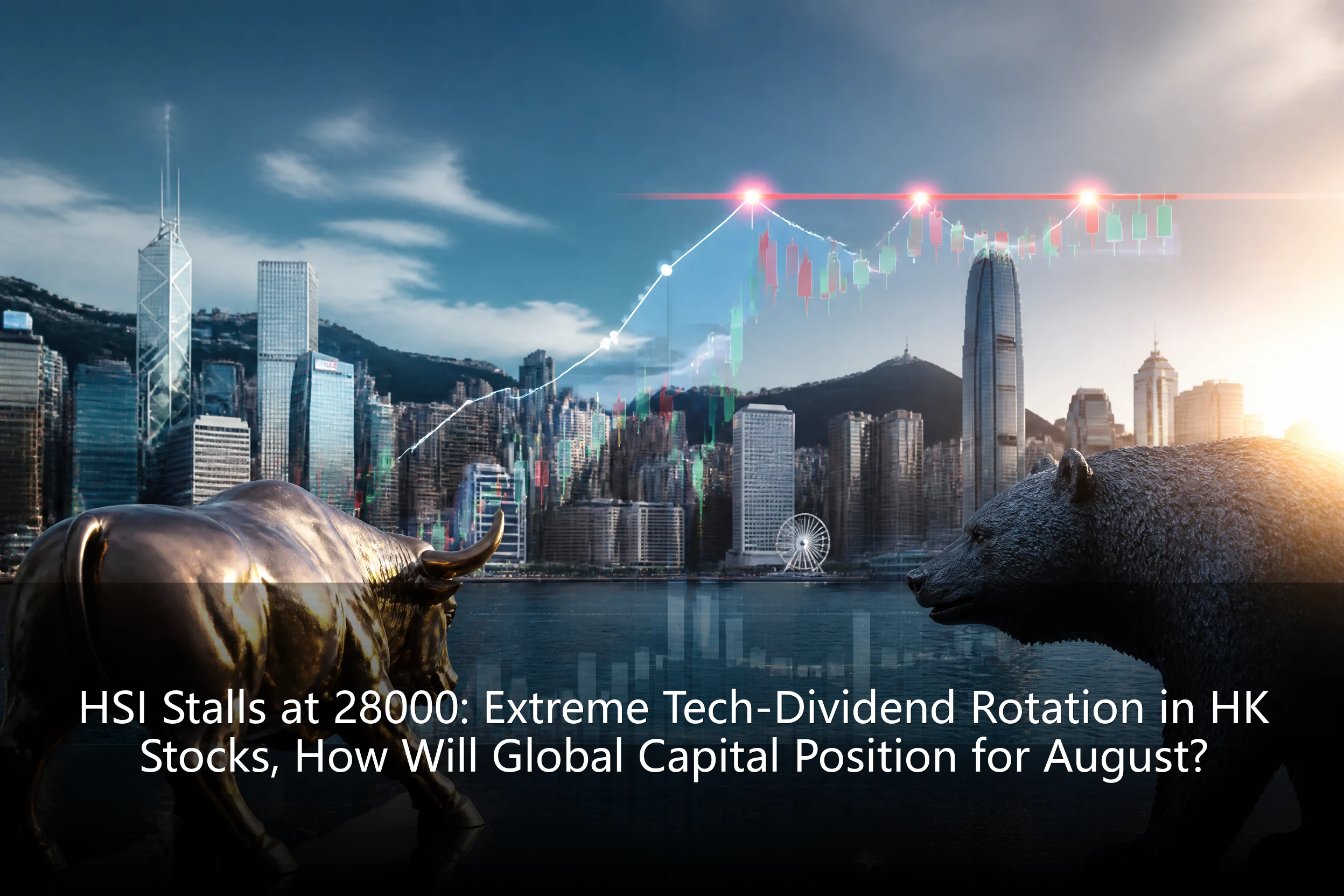
Introduction: Bull-Bear Game at the HSI 28000 Mark
In early August 2026, after a strong summer rebound, the HK market faced a bull-bear game at a key technical level. The Hang Seng Index met clear resistance testing the 28000 mark, with volatility rising significantly. As a vital hub for global capital allocating Chinese assets, HK stocks' recent performance reflects expectations of mainland macroeconomic recovery and capital rebalancing amid changing global liquidity. Currently, the market shows a distinct "tech + dividend" dual-drive and extreme rotation. This article analyzes support and resistance factors at the 28000 mark and outlines H2 asset allocation strategies for global investors.
1. Marginal Changes in Macro Environment and External Liquidity
Entering August 2026, the global macro environment entered a sensitive phase. Regarding overseas liquidity, after H1 observation, Fed rate cut expectations for H2 became the market focus. As some US economic data showed cooling signs, with manufacturing PMI and the job market weakening marginally, the Dollar Index fell in early August, and the 10-year US Treasury yield remained weak. This macro backdrop provides external liquidity support for valuation recovery in emerging markets and HK stocks.
However, liquidity improvement takes time. International capital often undergoes repeated testing when re-entering emerging markets. The HSI's stall at 28000 is essentially a "stress test" by global capital repricing Chinese assets, weighing the macro recovery slope against overseas liquidity easing. Here, incremental foreign capital acts more as a "floor" than an "attack," explaining the index's hesitation at key levels.
2. Extreme Tech-Dividend Rotation: Deep Market Structure Analysis
From live trading, the HK market's most notable feature recently isn't unilateral index moves, but extreme sector rotation. Growth sectors, represented by the Hang Seng Tech Index, and dividend sectors, represented by the Hang Seng High Dividend Index, show a clear "seesaw effect."
1. Tech Sector's Elasticity and Resistance
Tech led the earlier rebound. As AI applications landed in H1 2026, ad and cloud revenue for top tech internet firms improved materially, supporting the first wave of price recovery. However, near 28000, tech faced dual resistance: profit-taking at highs, and high interim earnings expectations where any slight miss could trigger sharp corrections. Thus, tech stocks saw increased intraday volatility with capital engaging in short-term buy-low sell-high trades.
2. Revaluation of Dividend Assets' Defensive Value
Contrasting tech's volatility, high-dividend sectors showed strong defensive properties when the index pulled back. Under low interest rates and an asset shortage, southbound capital's demand for HK high-dividend assets is long-term. Traditional dividend sectors like coal, telecom operators, utilities, and large state-owned banks bucked the trend during the early August pullback. This shows that when risk appetite falls, deterministic returns remain a safe haven. This extreme "tech offense, dividend defense" rotation is expected to dominate market rhythm throughout the August interim reporting period.
3. Southbound Capital Trends: Stabilizer and Style Switching
When analyzing the HK market, southbound capital flows are a core variable. Since 2026, continuous net inflows of southbound capital have been the core incremental funds supporting valuation recovery. In August, structural changes in these flows emerged.
First, the net inflow trend remains, but the pace slowed. Near 28000, southbound capital didn't chase highs blindly but shifted to buying on dips, reflecting mainland institutions' rational valuation judgment. Second, flows showed clear style balancing. During tech rallies, southbound capital increased allocations to Hang Seng Tech ETFs and internet leaders; when the index stalled, funds quickly returned to high-dividend ETFs and dividend stocks. This "barbell" strategy smooths portfolio volatility and reflects prudent investing under uncertainty. For global investors, tracking this style switch is a key indicator for HK short-term opportunities.
4. Interim Earnings Validation: Key Catalyst for Intensified Divergence
August is a dense window for HK interim reports. After prior valuation recovery, the market focus shifted from "policy expectations" to "earnings validation." Breaking 28000 requires strong earnings improvement expectations.
Fundamentally, divergence is intensifying. AI-related hardware and cloud service providers will likely meet or beat interim expectations, providing earnings-driven upside. Consumer electronics and traditional software firms, lacking substantive AI empowerment, face dual valuation and earnings risks. Meanwhile, dividend sectors' earnings stability will be reconfirmed. Although some cyclical dividend stocks (like upstream resources) might see sequential declines due to commodity price swings, ample cash flow and stable dividend willingness still attract long-term funds. Thus, in August, investors should highly guard against individual stock earnings landmines and select targets with high earnings certainty.
5. HK Stock Allocation from a Global Portfolio Perspective
As a global investment portfolio encyclopedia, GP Baike always advocates examining single-market volatility from a macro asset allocation perspective. Facing the bull-bear battle at the HSI 28000 mark, how should global investors adjust portfolios?
- Strategy 1: Adhere to a "Barbell" Balanced Allocation
Amid extreme market style rotation, betting solely on tech or dividend carries high volatility risk. Investors are advised to adopt a "barbell" strategy: allocate to top internet and AI computing leaders in the Hang Seng Tech Index for upside elasticity; overweight HK high-dividend blue chips or dividend ETFs for stable cash flow and to hedge systemic market drawdowns. Dynamically balancing weights can enhance returns while controlling risk.
- Strategy 2: Focus on Structural AH Premium Opportunities
Although the AH Premium Index has narrowed, some dual-listed financial, energy, and infrastructure blue chips still show significant premiums. For investors with both A-share and HK accounts, exploiting expectation gaps during the interim reporting period via arbitrage or mean reversion is an effective way to boost portfolio Alpha. High-dividend, low-valuation H-shares offer a thicker safety margin relative to A-shares.
- Strategy 3: Use Derivatives to Manage Downside Risk
For risk-averse capital near the 28000 mark, moderately using derivatives like put options or inverse ETFs for tail risk hedging is advisable. During fragile market sentiment around earnings releases, buying "insurance" at low cost effectively protects portfolios from sudden black swan shocks.
Conclusion: Forging Ahead Amid Volatility, Capturing HK Stocks' Long-Term Value Reassessment
Overall, the HSI's pullback at 28000 doesn't mean the end of the HK rebound, but a healthy technical correction after rapid gains. With marginal global liquidity improvements and China's steady macro recovery, HK stocks' valuation recovery logic remains solid. Short-term, extreme tech-dividend rotation and interim earnings validation will dominate; long-term, the repricing of quality Chinese assets has just begun.
For global investors, current short-term index volatility shouldn't be a distraction; instead, use the volatile window to optimize holdings. Through scientific asset allocation and rigorous fundamental screening, cutting through market noise allows investors to fully enjoy the dividends of HK stocks' long-term value reassessment in H2 2026 and beyond. GP Baike will continue tracking HK market hotspots, providing professional real-time news and strategies to help you navigate global capital markets steadily.